


How to Find Your Equipment Model Number.
听
Finding the right parts for your equipment is easy when you have your model and serial number which can be found on the data plate. Luckily, a forklift data plate is installed on every truck on the market to help you understand what your forklift can do and provide vital information.
听
Model Number:听The model number of your toyota forklift is extremely important for relaying information to your dealers about repair or technical assistance and for looking up replacements part!
听
Serial Number:听The serial number on your lift is the most important number.The model serial number combination will allow us to provide you with the parts that will fit your particular piece of equipment.
听

How to Find Your Equipment Serial Number.
听
Finding the right parts for your equipment is easy when you have your model and serial number which can be found on the data plate. Luckily, a forklift data plate is installed on every truck on the market to help you understand what your forklift can do and provide vital information.
听
Model Number:听The model number of your toyota forklift is extremely important for relaying information to your dealers about repair or technical assistance and for looking up replacements part!
听
Serial Number:听The serial number on your lift is the most important number.The model serial number combination will allow us to provide you with the parts that will fit your particular piece of equipment.
听

Need some help? For further assistance or more information, contact your local Toyota Dealer.


Please click below to sign in to your MyToyota account
Don't have an account?
How To Read Toyota Forklift Model Numbers

Quick Summary:听Toyota forklift model numbers are structured codes that help identify key equipment specifications, series, and configuration details. Each letter and number represents important information such as model series, fuel type, tire type, and load capacity. Understanding these codes makes it easier to communicate with service teams, order the right parts, and manage equipment more efficiently.
If you operate a Toyota forklift, you鈥檝e likely noticed that every truck has a model number made up of letters and numbers. While many teams create nicknames to easily identify forklifts within their fleet, those nicknames don鈥檛 provide the technical information needed when ordering parts, scheduling service, or communicating with your Toyota dealer.
听
Understanding the structure can make managing your equipment much easier. Each character in the model number represents specific details about the forklift, including the series, fuel type, tire configuration, and load capacity.
听
Once you know how to read a Toyota forklift model number, you can quickly identify key specifications about your equipment and communicate more effectively with service technicians, dealers, and other facilities.
听
In this guide, we鈥檒l break down Toyota forklift model numbers and explain what each letter and number means so you can easily identify the forklifts in your fleet.
Toyota Forklift Model Numbers Up To 17,500 lbs.
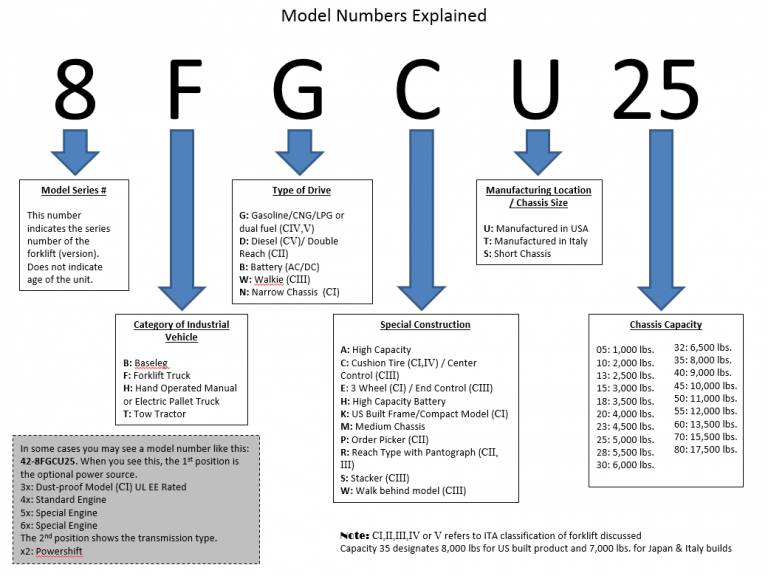
There are two general model number formats for Toyota forklifts which are split up based on forklift capacity. The first format covers models with base capacities of up to 17,500 lbs.
*Rated capacities should always be checked on the forklift data plate, which will be specific to your forklift鈥檚 configuration
听
As you can see in the diagram above, most models begin with a number signifying which model series it belongs to. For example, an 鈥�8鈥� means that this forklift is an 鈥�8-series鈥� model. Since model numbers are sequential, a higher number generally translates to a newer model.
听
The model series is followed by a series of letters, the first of which designates the category of the industrial vehicle. A 鈥淏鈥� after the model series designator indicates the forklift has baselegs, which is commonly seen in model numbers for reach trucks and walkie stackers. The remaining explanations are pretty self-explanatory.
听
The third character in the model number indicates the type of drive or fuel type:
听
- 鈥淕鈥� indicates it is powered by LP or gasoline.
- 鈥淒鈥� stands for diesel-powered.
- 鈥淏鈥� stands for battery-powered.
- On Class III products, a 鈥淲鈥� in this position indicates that a forklift is a walk-behind unit.
- For Class, I products, an 鈥淣鈥� designates that the forklift has a narrow chassis, which commonly indicates that the product is a stand-up, counterbalanced model.
听
The next character indicates a unique construction and is not present in all models. A model with cushion tires has a 鈥淐鈥� in this position, and the lack of a letter 鈥淐鈥� means that the forklift has pneumatic tires.
听
One tricky character here can be the letter 鈥淓鈥�, which can mean the truck is a 3-wheel electric听or听an end control rider model. The difference is easily distinguishable by looking at the entire model number. Any model with an 鈥淔鈥� in it is a forklift and any with an 鈥淗鈥� are hand operated. So an 鈥�8FBE15U鈥� is a 3-wheel electric model and an 鈥�8HBE30鈥� is an end-controlled rider. Three-wheel electric models also have optional pneumatic tires, so you can鈥檛 rely on the model number alone to determine tire type in this case.
听
The next letter is generally a 鈥淯鈥� signifying that the forklift was built in the United States. If there is no 鈥淯鈥�, it means the forklift was built somewhere outside of the United States. There are some models where an 鈥淪鈥� actually appears before the 鈥淯鈥�, which indicates the vehicle has a short chassis. An example of this would be the 8FGCSU20. As of 2013, Toyota began placing the 鈥淯鈥� at the end of the model number with the launch of the mid and large IC models built in Columbus, Indiana. This trend will continue to occur going forward.
听
Last, but not least, is the base capacity indicator. There are some exceptions, as noted above, but generally, the number represents base capacity in tons with one decimal place. So a 鈥�25鈥� here would indicate that the base capacity is 2.5 tons or 5,000 lbs. Tonnage is sometimes rounded due to the fact that two numbers for tonnage are used. Be sure to always refer to your forklift鈥檚 data plate for capacity information related to your specific forklift configuration.
Toyota Forklift Model Numbers Above 15,000 lbs.
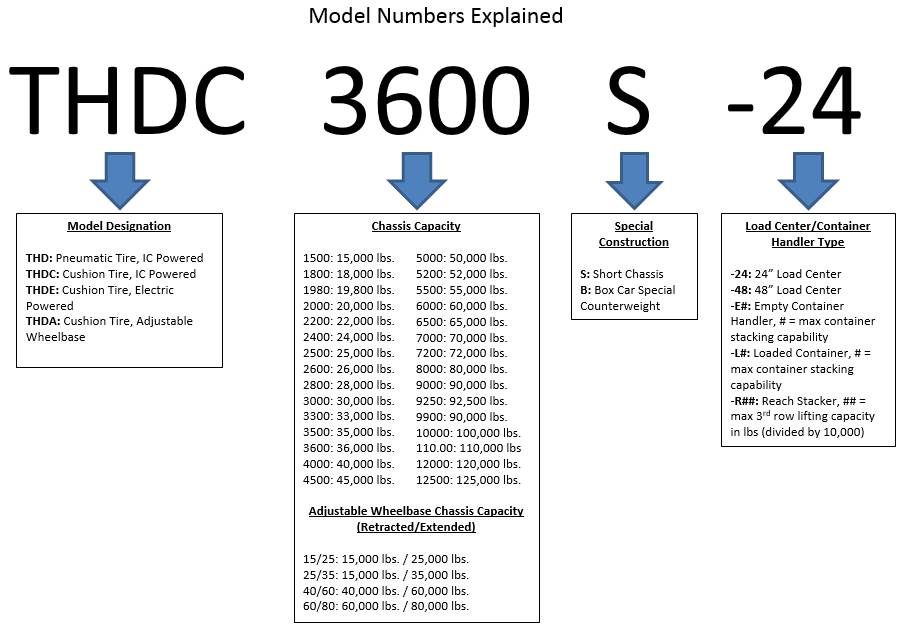
The second model number format applies to Toyota鈥檚 THD model lineup with capacities of 15,000 lbs and above.
*Rated capacities should always be checked on the forklift data plate, which will be specific to your forklift鈥檚 configuration
听
THD models have four unique designators, beginning with the model designation. 鈥淭HDC鈥� means it is a cushion tire IC model while 鈥淭HDE鈥� means it鈥檚 a cushion tire electric. 鈥淭HD鈥� alone means that it is an IC forklift with pneumatic tires. Pretty simple, right?
听
The next part of the model number represents the truck鈥檚 base lifting capacity in pounds. All you have to do is multiply the number by 10 (or add a zero to the end of it). So 鈥�2200鈥� means the base capacity is 22,000 lbs and 鈥�12500鈥� means the base capacity is 125,000 lbs. As with the lower capacity models, be sure to always refer to your forklift鈥檚 data plate for capacity information related to your specific forklift configuration.
听
The third designator indicates a special construction with 鈥淪鈥� indicating a short chassis model and a 鈥淏鈥� indicating a box car special model with a special, compact counterweight.
听
Finally, the last part represents the load center or the container handler type if it鈥檚 a port equipment model. A dash followed by two numbers tells you the truck鈥檚 load center for its rated base capacity. For example, a 鈥�-24鈥� means the base capacity is rated at a 24鈥� load center. A dash followed by an 鈥淓鈥� tells you it鈥檚 an empty container handler model, while an 鈥淟鈥� stands for loaded container handler, and an 鈥淩鈥� stands for reach stacker. The number following an 鈥淓鈥� or an 鈥淟鈥� is the maximum container stacking height for the container handler. The number following an 鈥淩鈥� states the maximum lift capacity of the reach stacker for the third row.
听
Now that you know how Toyota forklift model numbers work, identifying the key characteristics of your equipment should be much easier. With this understanding, you can quickly recognize the specs and capabilities of the forklifts in your fleet.
听